If you're designing a research study, you'll need to understand independent and dependent variables. These two concepts form the backbone of experimental design. They help you test cause-and-effect relationships and draw valid conclusions from your data.
In this guide, you'll learn what makes a variable independent or dependent, how to identify them in different research contexts, and how to use them correctly in your own studies. We'll walk through practical examples so you can see exactly how these concepts apply to real research situations.
What is a Variable?
As the name implies, a variable is something that varies. In research and statistics, a variable is a data item that can hold more than one value. These values can represent anything from names, addresses, numbers, categories, measurements, or other characteristics.
Variables are the building blocks of research. They allow researchers to measure, compare, and analyze different aspects of phenomena. Every quantitative study involves at least one variable, and most studies examine relationships between multiple variables.
What are Dependent Variables?
A dependent variable is what you measure in your experiment. As the name suggests, it depends on something else (specifically, the independent variable).
Think of it as the outcome you're interested in. It's the result, the effect, the thing that "responds" when you change the independent variable. Whatever happens to your dependent variable tells you whether your experimental manipulation worked.
Other names for dependent variables:
- Response variable
- Outcome variable
- Criterion variable
- Measured variable
- Effect variable
Example: If you're testing how different teaching methods affect student test scores, the test scores would be your dependent variable because they depend on which teaching method was used.
What are Independent Variables?
An independent variable is what you manipulate or control in your study. It's the factor you're testing to see if it causes changes in your dependent variable.
Here's the key: the independent variable doesn't depend on anything else in your experiment. You, as the researcher, decide what values it takes. You're testing whether changing this variable causes changes in something else (the dependent variable).
Other names for independent variables:
- Predictor variable
- Treatment variable
- Explanatory variable
- Manipulated variable
- Factor
- Cause variable
Example: If you're testing how different teaching methods affect student test scores, the teaching method would be your independent variable because it's what you're manipulating to see its effect.
Independent vs Dependent Variables: Key Differences
| Aspect | Independent Variable | Dependent Variable |
|---|---|---|
| Role | What the researcher manipulates | What the researcher measures |
| Causation | Cause | Effect |
| Depends on | Nothing (controlled by researcher) | Independent variable |
| Position in hypothesis | Comes first | Comes second |
| Graph placement | X-axis (horizontal) | Y-axis (vertical) |
How to Identify Independent and Dependent Variables
To identify which variable is independent and which is dependent, ask yourself:
- What am I trying to measure or predict? → This is your dependent variable
- What factor might influence or cause changes in that measurement? → This is your independent variable
- Which variable comes first in time? → This is usually your independent variable
The independent variable is the presumed cause, while the dependent variable is the presumed effect.
Examples of Independent and Dependent Variables
Example 1: Memory Retention Study
Research Question: Does the amount of sleep affect memory retention?
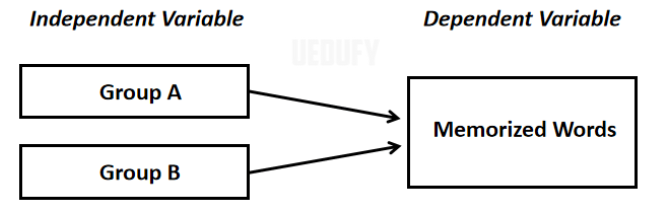 Conceptual framework showing the relationship between sleep duration and memory retention
Independent Variable: Amount of sleep (manipulated: 4 hours, 6 hours, 8 hours)
Dependent Variable: Number of words memorized (measured outcome)
Research Design: Participants are randomly assigned to three groups with different sleep durations. The next day, all participants take a memory test where they try to recall a list of 50 words they studied the previous evening.
Why this matters: This design allows researchers to determine if sleep duration (independent variable) has a causal effect on memory performance (dependent variable).
Potential applications:
- Testing the impact of sleep on academic performance
- Evaluating memory supplement efficacy
- Understanding optimal sleep requirements for learning
Example 2: Internal Communication Study
Research Question: How do different communication methods affect employee engagement?
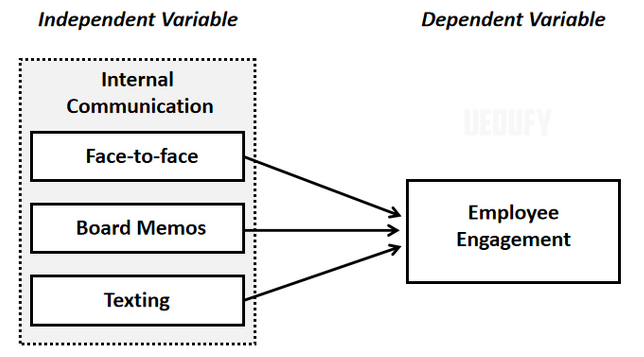 Conceptual framework illustrating communication methods as predictors of employee engagement
Independent Variable: Communication method (three types: face-to-face meetings, board memos, text messaging)
Dependent Variable: Employee engagement score (measured through surveys)
Research Design: Employees in different departments receive organizational updates through different communication channels. After three months, all employees complete an engagement survey.
Why this matters: Organizations can use these findings to optimize their internal communication strategies and improve employee engagement.
Example 3: English Learning Methods
Research Question: Which English learning method is most effective for adult learners?
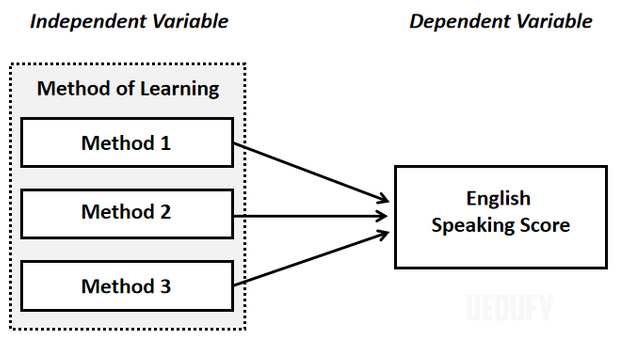 Conceptual framework comparing three English learning methods
Independent Variable: Learning method (three types: traditional textbooks, one-to-one tuition, online course)
Dependent Variable: English speaking proficiency score (standardized test)
Research Design: Adult learners are randomly assigned to one of three learning methods. After six months, all participants take the same standardized English speaking test.
Why this matters: Educational institutions and language learners can make informed decisions about which learning method provides the best outcomes.
Example 4: Gender and Leadership Styles
Research Question: Does gender influence leadership style in corporate environments?
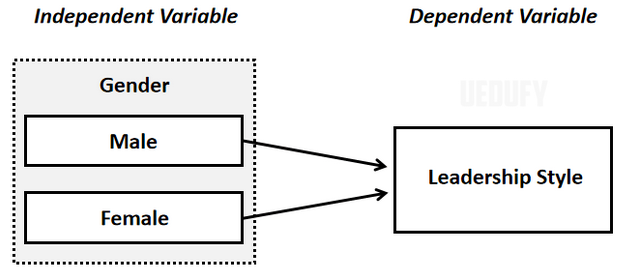 Conceptual framework examining gender as a predictor of leadership style
Independent Variable: Gender (categorical: male, female)
Dependent Variable: Leadership style (measured using validated leadership assessment instruments)
Research Design: Corporate leaders complete leadership style assessments, and researchers analyze whether there are systematic differences based on gender.
Why this matters: Understanding these relationships can inform diversity initiatives and leadership development programs.
How to Use Variables in Research
1. Start with a Research Question
Every study begins with a clear research question that identifies what you want to investigate. Your research question should suggest both what you'll measure (dependent variable) and what factors might influence it (independent variables).
2. Review Existing Literature
Before selecting your variables, conduct a thorough literature review. Examine previous studies to understand:
- Which variables have been studied before
- What relationships have been found
- Which measurement methods are most reliable
- What gaps exist in current knowledge
3. Define Your Variables Operationally
You need to be specific about how you'll measure or manipulate each variable. Vague concepts like "stress" or "happiness" won't work. You need concrete, measurable definitions.
This matters because operational definitions make your study:
- Replicable (others can do exactly what you did)
- Clear (no ambiguity about what you measured)
- Valid (you can compare your results to other studies)
Example: Instead of studying "stress" (too vague), you might operationally define it as "cortisol levels measured via saliva samples" or "score on the Perceived Stress Scale (PSS-10)."
4. Consider Confounding Variables
Confounding variables are factors that might influence your dependent variable besides your independent variable. Good research design controls for these through:
- Random assignment
- Statistical controls
- Matching participants
- Standardized procedures
5. Select Appropriate Statistical Tests
The types of variables you have (categorical, continuous, ordinal) determine which statistical tests are appropriate:
- Continuous dependent variable + categorical independent variable: t-test or ANOVA
- Continuous dependent variable + continuous independent variable: correlation or regression
- Categorical dependent variable: chi-square test or logistic regression
Multiple Independent Variables
Many studies test more than one independent variable at once. These are called factorial designs, and they're powerful because they let you see how variables interact.
Example: A study might examine how both teaching method (independent variable 1) and class size (independent variable 2) affect test scores (dependent variable).
Why use multiple independent variables? You can:
- See how variables interact (maybe online learning works better in small classes but worse in large ones)
- Control for confounding factors
- Mirror real-world complexity
- Get more information from the same number of participants
Common Mistakes to Avoid
Confusing Correlation with Causation
Just because two variables are related doesn't mean one causes the other. For a true causal relationship, you need three things: the cause must come before the effect, the variables must change together, and you must rule out other explanations.
Measuring Variables Inconsistently
Use the same procedures, instruments, and conditions for all participants. If you measure some people's blood pressure in the morning and others' in the evening, you're introducing error that could mask your real results.
Ignoring Confounding Variables
Don't assume your independent variable is the only thing affecting your dependent variable. Always ask: what else could explain these results?
Poor Operational Definitions
Vague definitions make replication impossible. If you study "aggression" without defining exactly what behaviors count as aggressive, no one (including you) can repeat your study.
Wrapping Up
Independent and dependent variables are the foundation of experimental research. The independent variable is what you manipulate, and the dependent variable is what you measure to see if your manipulation had an effect.
Here's what matters most:
- The independent variable is the presumed cause (you control it)
- The dependent variable is the measured effect (it responds to changes in the IV)
- Always define your variables operationally so others can replicate your work
- Control for confounding variables that might muddy your results
- Remember: correlation doesn't equal causation
Once you understand these concepts, you'll find it much easier to design studies, interpret research papers, and spot methodological problems in published work.